20th Century Wars
Uncle Joe
“Uncle Joe would take me on walks about camp, speaking pleasantly to me.”
“Uncle Joe would take me on walks about camp, speaking pleasantly to me.”

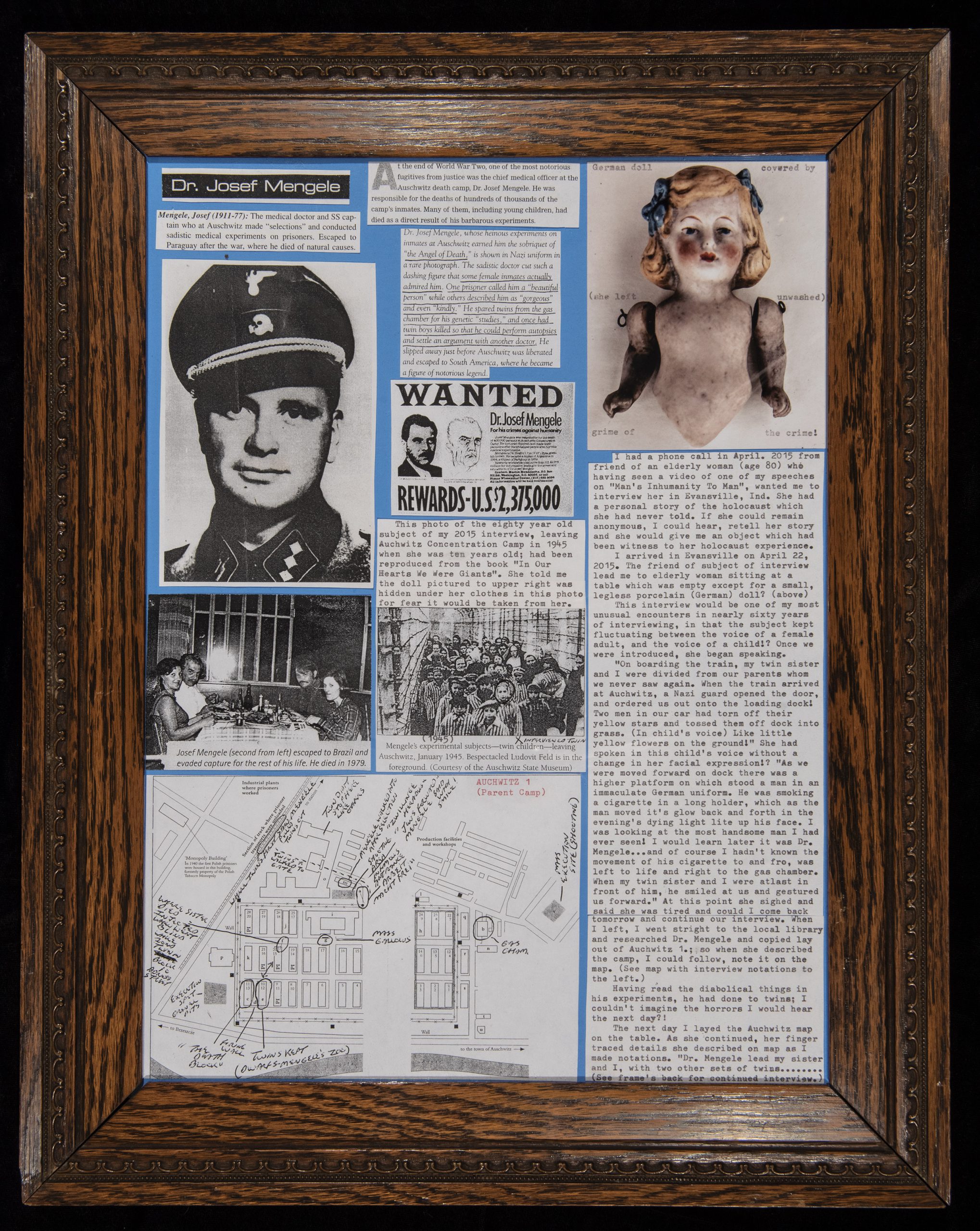
I had a phone call in April, 2015 from friend of an elderly woman (age 80) who having seen a video of one of my speeches on “Man’s Inhumanity To Man,” wanted me to interview her in Evansville, Ind. She had a personal story of the holocaust which she had never told. If she could remain anonymous, I could hear, retell her story and she would give me an object which had been witness to her holocaust experience.
I arrived in Evansville on April 22, 2015. The friend of subject of interview lead me to elderly woman sitting at a table which was empty except for a small, legless porcelain (German) doll? This interview would be one of my most unusual encounters in nearly sixty years of interviewing, in that the subject kept fluctuating between the voice of a female adult, and the voice of a child! Once we were introduced, she began speaking: “On boarding the train, my twin sister and I were divided from our parents whom we never saw again. When the train arrived at Auschwitz, a Nazi guard opened the door, and ordered us out onto the loading dock! Two men in our car had torn off their yellow stars and tossed them off dock into grass. (In child’s voice) Like little yellow flowers on the ground!” She had spoken in this child’s voice without a change in her facial expression! “As we were moved forward on dock there was a higher platform on which stood a man in an immaculate German uniform. He was smoking a cigarette in a long holder, which as the man moved its glow back and forth in the evening’s dying light lit up his face. I was looking at the most handsome man I had ever seen! I would learn later it was Dr. Mengele… and of course I hadn’t known the movement of his cigarette to and fro, was left to life and right to the gas chamber. When my twin sister and I were at last in front of him, he smiled at us and gestured us forward.” At this point she sighed and said she was tired and could I come back tomorrow and continue our interview.
When I left, I went straight to the local library and researched Dr. Mengele and copied layout of Auschwitz, so when she described the camp, I could follow, note it on the map. (See map with interview notations.) Having read the diabolical things in his experiments, he had done to twins; I couldn’t imagine the horrors I would hear the next day!
The next day I laid the Auschwitz map on the table. As she continued, her finger traced details she described on map as I made notations. “Dr. Mengele lead my sister and I, with two other sets of twins, straight from unloading dock through a building, while all the others were marched around to another building on our left. At building 111 Mengele with a big smile went inside, turning us over to two female guards who holding our hands took us around to and through that main camp gate with sign “ARBEIT MACHT FREI.” We walked down lines of long buildings until we arrived at that building numbered 10/12. This building for all twin children and for dwarfs, was what I learned later was referred to as “Mengele’s Zoo.” This is where my sister and I stayed, before my sister became ill and was moved to PI 20/15.” Then she added in child’s voice after brief silence, “That’s where she died though Uncle Joe tried to save her.” She rubbed her teary eyes like a crying child does… but when she looked back up at me, she was female adult again as she continued. “From 1944 until Auschwitz liberation in 1945, I spent my entire time in block 10/12.”
I hesitated before bringing out from beneath cap map, and a photo of Dr. Mengele, and placing it before her, I asked “What had he done to you?” She gazed down at photo of Mengele in emotionless silence, before touching his face with her aged finger. In that disturbing, haunting child’s voice she had finally responded “He was more handsome in person.” The way she had said this shocked me. Then back to adult voice, “You see Jim, he was kind to me. He’d come to block to see me, sometimes sitting me on his knee, talking sweetly to me more than any other of the twins, who were all treated better than any others in camp except the dwarves. Our block was clean and neatly decorated. We were dressed better and fed more. Uncle Joe would take me on walks about camp, speaking pleasantly to me. Once he had even taken me when his wife visited, outside the camp to go swimming with them!” My mind was swimming with confusion. Could what I was hearing from this elderly female, the fantasies of that child in her evidence in that occasional child’s voice? “Jim, I know they called Dr. Mengele “The Angel of Death”, but in his immaculate uniform, sweet smelling cologne, and gentle manner…he had only been kind to me. I remember how compassionate he’d been when he’d tried to save my ill twin sister over in block building PI 20/15!” (I knew by camp map location legend I had left off her library copy of Auschwitz lay out, so I could compare her memory to actual details, block PI 20/15 where Mengele had told her he had tried to save her ill twin sister was where the doctor had injected, blinded and murdered twins in genetic eye experiments!) “That is my story, Jim. Our interview is over.”
Her friend brought out tea. More confused than enlightened by the interview, I asked her about her health? “Well Jim, besides failing eyesight and darn arthritis, I’m doing fine. I’m not afraid to die; it’s been too long since I’ve seen my beloved father and mother and my darling twin sister.” She stared off, before adding in that child’s voice “I want to hug and kiss them again. Mommy had beautiful brown eyes. Mine are blue.” Seeing she was tiring, I asked her why she had never told her story of the holocaust before? Back to adult voice, she sighed “They have enough of the survivors’ stories; besides they don’t really want to hear mine.” As she slowly stood up, I had realized she had never explained the legless doll on the table. “How does the doll connect to your story?” She tenderly picked the doll up off the table. “Dr. Mengele gave it to me to try to console me for the loss of my twin sister. It symbolizes his kindness to me… the Angel of Death I have described, is not the one they want to hear about.”
I realized in that moment the interview had revealed a personal view of Dr. Mengele which I had not been prepared to hear about! Had this woman been so deranged by her Auschwitz experience, guilt over having been treated so well and survived, she had a self-imposed psychological blindness to the monster Dr. Mengele had actually been? I placed the Auschwitz map and photo of Dr. Mengele in my folder as she handed me the doll. At the door, I thanked her, and pledged to be true to her story in its retelling. We shook hands and I turned to leave, when she clutched my shirt sleeve. There were tears in those failing blue eyes, as she said in that child’s voice something which still echoes in my mind, haunts my heart: “I…I didn’t know WHAT THAT SMELL WAS?” Not until I was in my car driving back to Ohio did I realize what the child in that elderly woman had meant by “THAT SMELL”… the bodies of the murdered Jews burning in the ovens of Auschwitz!
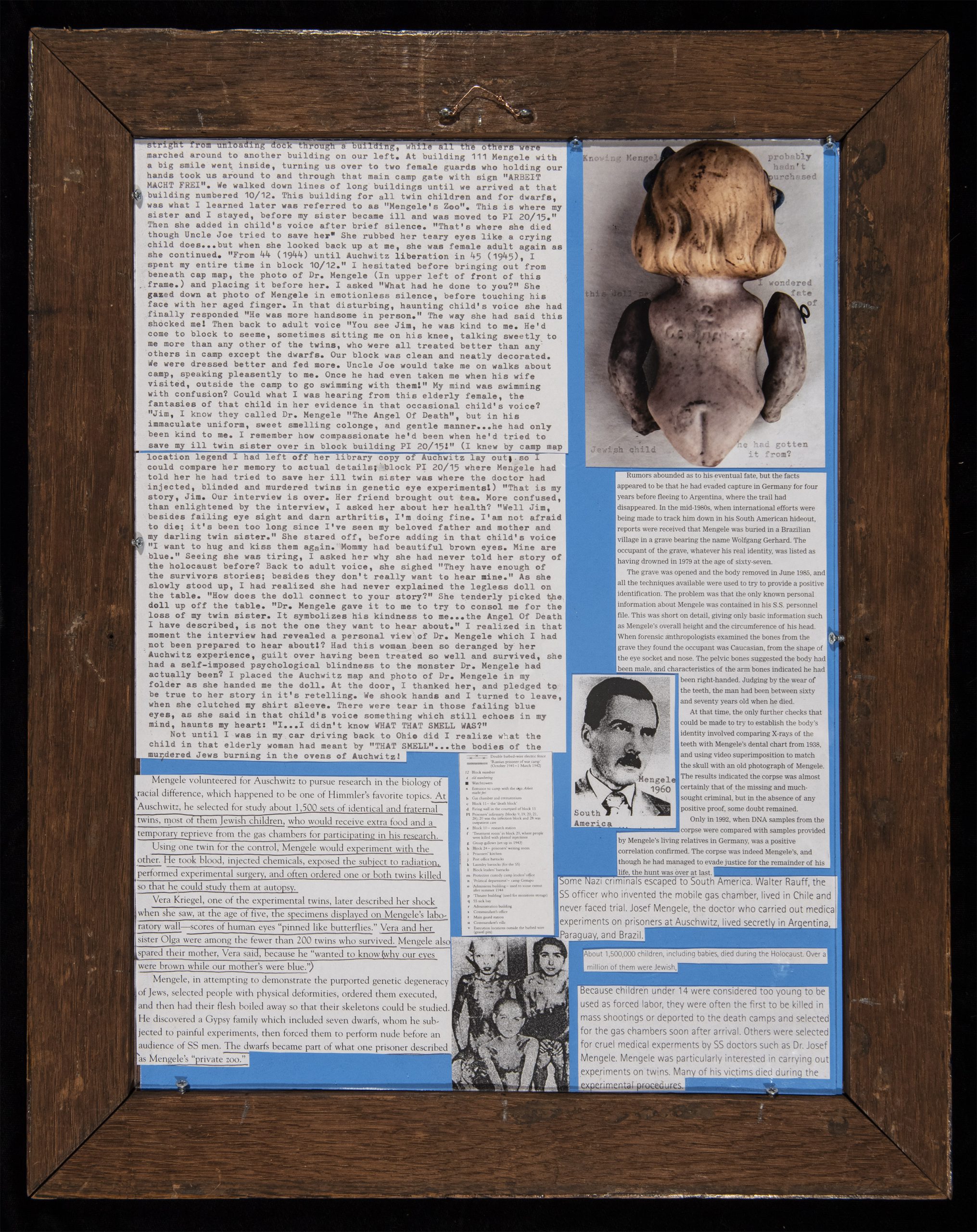

In these framed pieces, Jim tells the story of each object and, importantly, preserves his original research and documentation. In many instances, the story concludes on the back of the frame. In cases where the similarity of content may cause confusion for viewers, the beginning of the story is highlighted.