(Extra)Ordinary People • The Unexplained
Crazy Otto’s Dream System
“Numbers are letters!”
“Numbers are letters!”

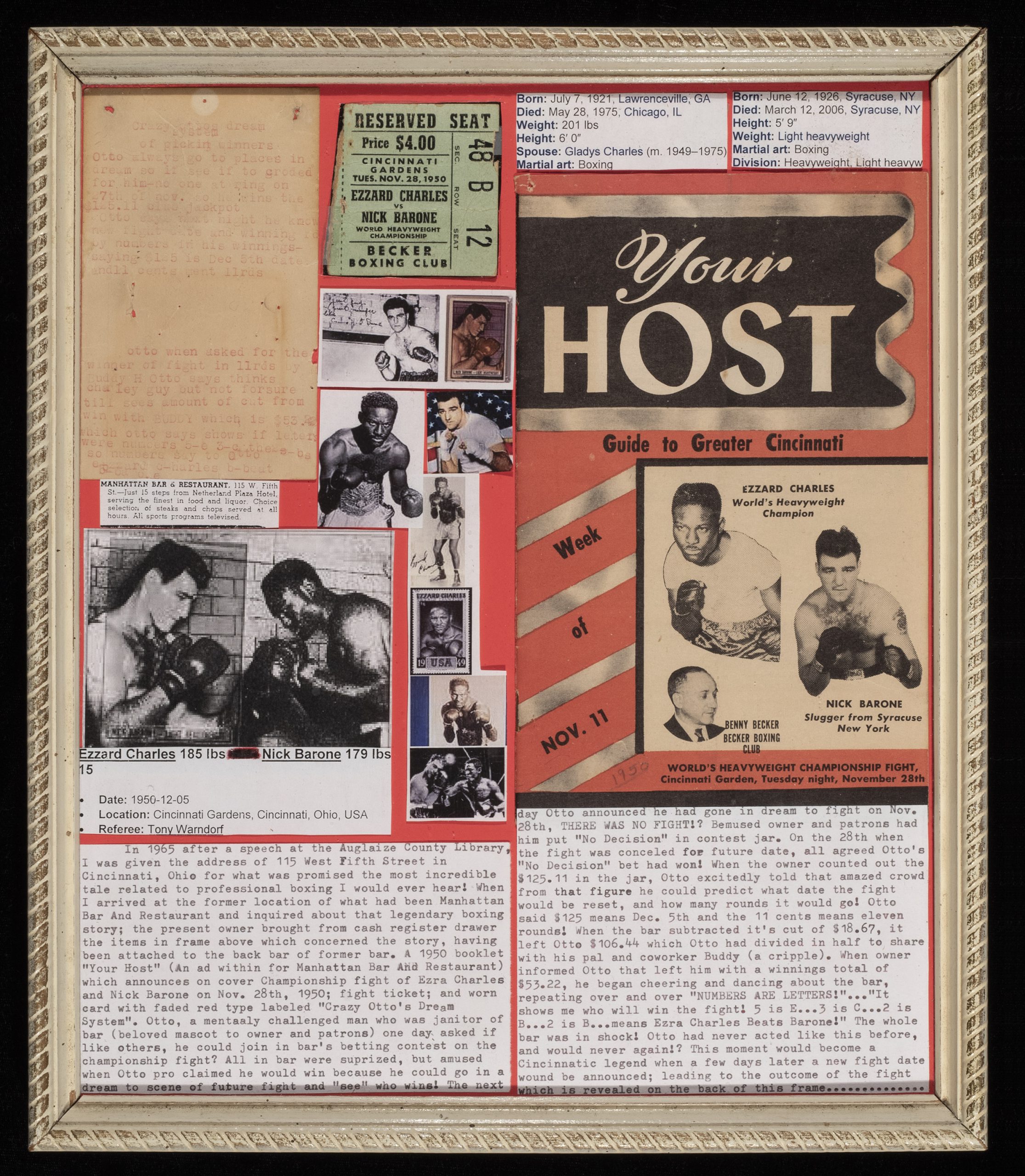
In 1965, after a speech at the Auglaize County Library, I was given the address of 115 West Fifth Street in Cincinnati, Ohio, for what was promised the most incredible tale related to professional boxing I would ever hear! When I arrived at the former location of what had been Manhattan Bar and Restaurant and inquired about that legendary boxing story, the present owner brought from cash register drawer the items which concerned the story, having been attached to the back bar of former bar.
A 1950 booklet “Your Host” (an ad within for Manhattan Bar and Restaurant) which announces on cover Championship fight of Ezra Charles and Nick Barone on Nov. 28th, 1950; fight ticket; and worn card with faded red type labeled “Crazy Otto’s Dream System.” Otto, a mentally-challenged man who was janitor of bar (beloved mascot to owner and patrons) one day, asked if, like others, he could join in bar’s betting contest on the championship fight? All in bar were suprised, but amused when Otto proclaimed he would win because he could go in a dream to scene of future fight and “see” who wins!
The next day Otto announced he had gone in dream to fight on Nov. 28th, THERE WAS NO FIGHT! Bemused owner and patrons had him put “No Decision” in contest jar. On the 28th when the fight was canceled for future date, all agreed Otto’s “No Decision” bet had won! When the owner counted out the $125.11 in the jar, Otto excitedly told that amazed crowd from that figure he could predict what date the fight would be reset, and how many rounds it would go! Otto said $125 means Dec. 5th and the 11 cents means eleven rounds! When the bar subtracted its cut of $18.67, it left Otto $106.44 which Otto had divided in half to share with his pal and coworker Buddy (a cripple.) When owner informed Otto that left him with a winnings total of $53.22, he began cheering and dancing about the bar, repeating over and over “NUMBERS ARE LETTERS!”…”It shows me who will win the fight! 5 is E…3 is C…2 is B…2 is B.. means Ezra Charles Beats Barone!” The whole bar was in shock! Otto had never acted like this before, and would never again!
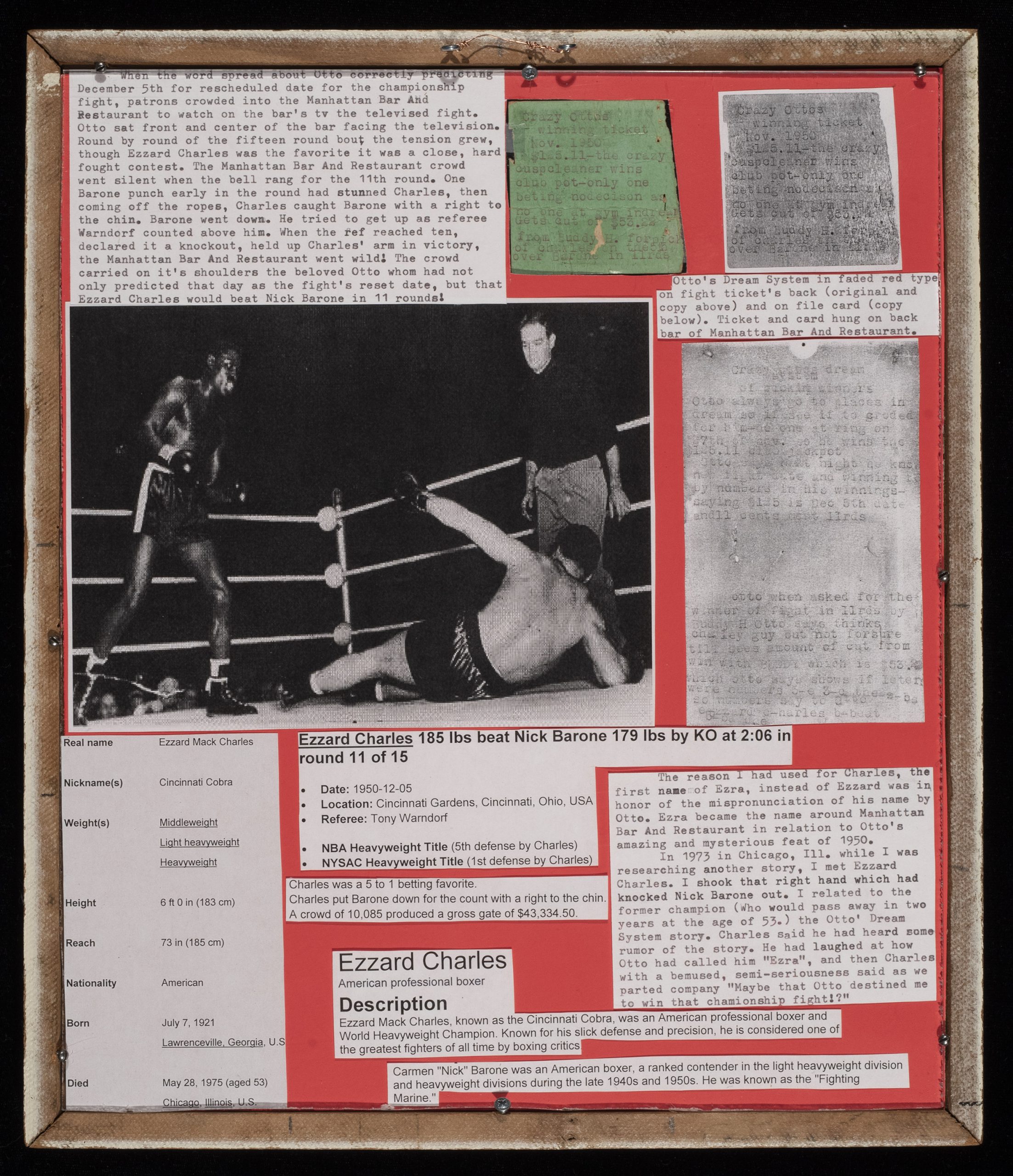
This moment would become a Cincinnati legend when a few days later a new fight date would be announced. When the word spread about Otto correctly predicting December 5th for rescheduled date for the championship fight, patrons crowded into the Manhattan Bar and Restaurant to watch on the bar’s TV the televised fight. Otto sat front and center of the bar facing the television. Round by round of the fifteen round bout the tension grew, though Ezzard Charles was the favorite it was a close, hard fought contest. The Manhattan Bar and Restaurant crowd went silent when the bell rang for the 11th round. One Barone punch early in the round had stunned Charles, then coming off the ropes, Charles caught Barone with a right to the chin. Barone went down. He tried to get up as referee Warndorf counted above him. When the ref reached ten, declared it a knockout, held up Charles’ arm in victory, the Manhattan Bar and Restaurant went wild! The crowd carried on its shoulders the beloved Otto whom had not only predicted that day as the fight’s reset date, but that Ezzard Charles would beat Nick Barone in 11 rounds!
The reason I had used for Charles, the first name of Ezra, instead of Ezzard, was in honor of the mispronunciation of his name by Otto. Ezra became the name around Manhattan Bar and Restaurant in relation to Otto’s amazing and mysterious feat of 1950.
In 1973, in Chicago, Ill. while I was researching another story, I met Ezzard Charles. I shook that right hand which had knocked Nick Barone out. I related to the former champion (who would pass away in two years at the age of 53) the Otto’s Dream System story. Charles said he had heard some rumor of the story. He had laughed at how Otto had called him “Ezra,” and then Charles with a bemused, semi-seriousness said as we parted company, “Maybe that Otto destined me to win that championship fight?”

In these framed pieces, Jim tells the story of each object and, importantly, preserves his original research and documentation. In many instances, the story concludes on the back of the frame. In cases where the similarity of content may cause confusion for viewers, the beginning of the story is highlighted.