Racism and Civil Rights
The Night Riders Club
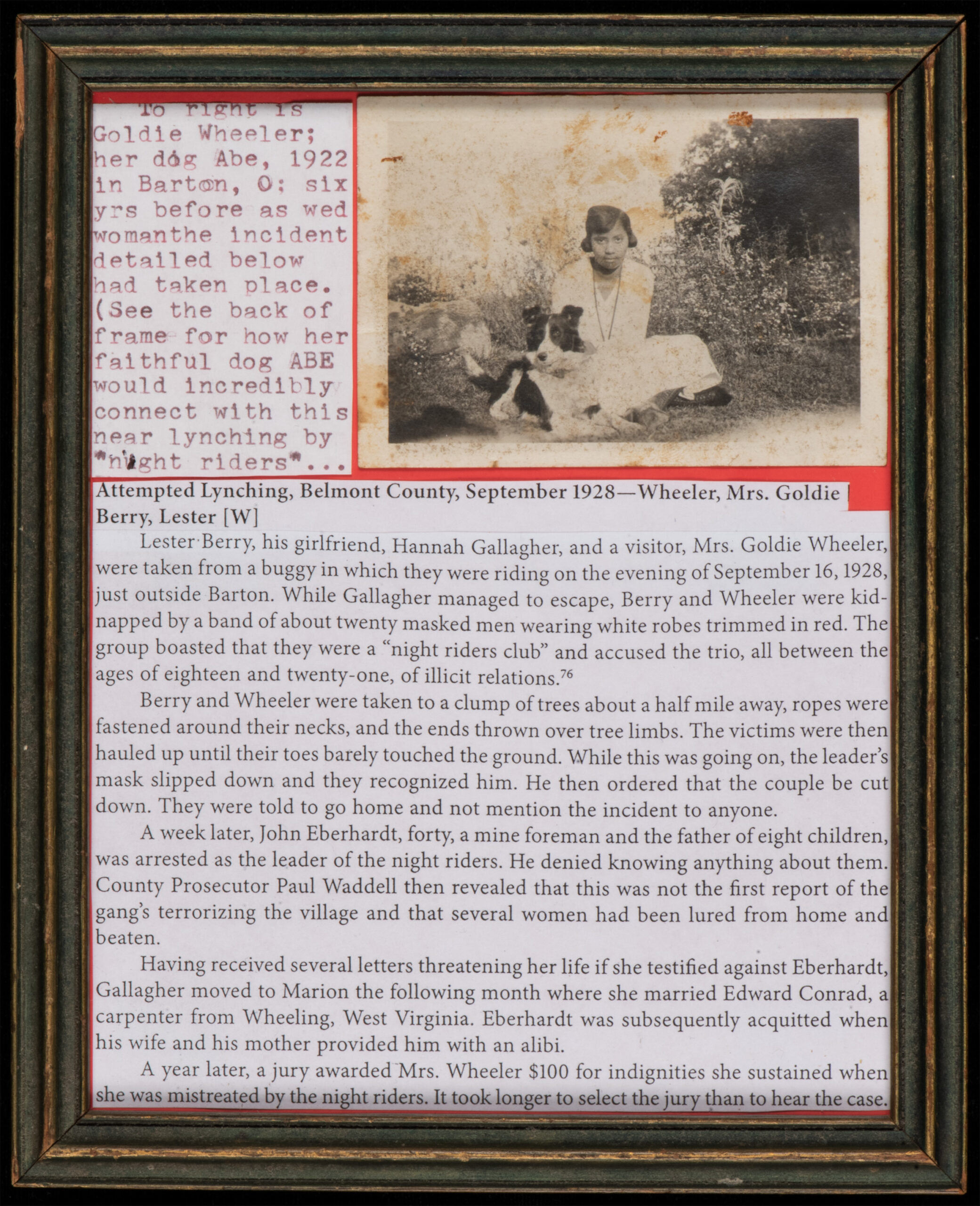
An Ohio woman survives an attempted lynching; did her dog identify the gang’s ringleader?
An Ohio woman survives an attempted lynching; did her dog identify the gang’s ringleader?

The photo shows Goldie Wheeler and her dog Abe, 1922, in Barton, Ohio, six years before as wed woman the incident detailed on the front of the frame had taken place.
The self-confidence one detects on the face of Goldie Wheeler, a highly intelligent, charming young Black girl in the photo taken six years before the infamous racist incident, WAS GONE, a condition from which she would never fully recover! She would carry rope burn marks on her neck, to match those left on her psychologically for the rest of her life!
The first strange manifestation of her dog Abe (the devoted pet not having been present at the incident) was its constant licking of the rope burns, while emitting a sympathetic whining for his beloved Goldie. Then Barton, Ohio, citizens began to notice that when Goldie was in town with Abe, the characteristically good natured dog had begun growling at a number of local men, many suspected of being in “The Night Riders Club!” One day in summer of 1929 at a local fair, Abe had suddenly began growling from a low crouch, hair standing up on its back, at one man in particular! Abe continued to follow, growling at the man until cursing, kicking at it, the man had fled the fairground. Word of the mysterious reaction of Abe reached the sheriff who then arrested this man, John Eberhardt, already suspected of being the leader of the racist club. Goldie claimed no conscious memory of this man as her assailant until her faithful dog Abe’s reaction!
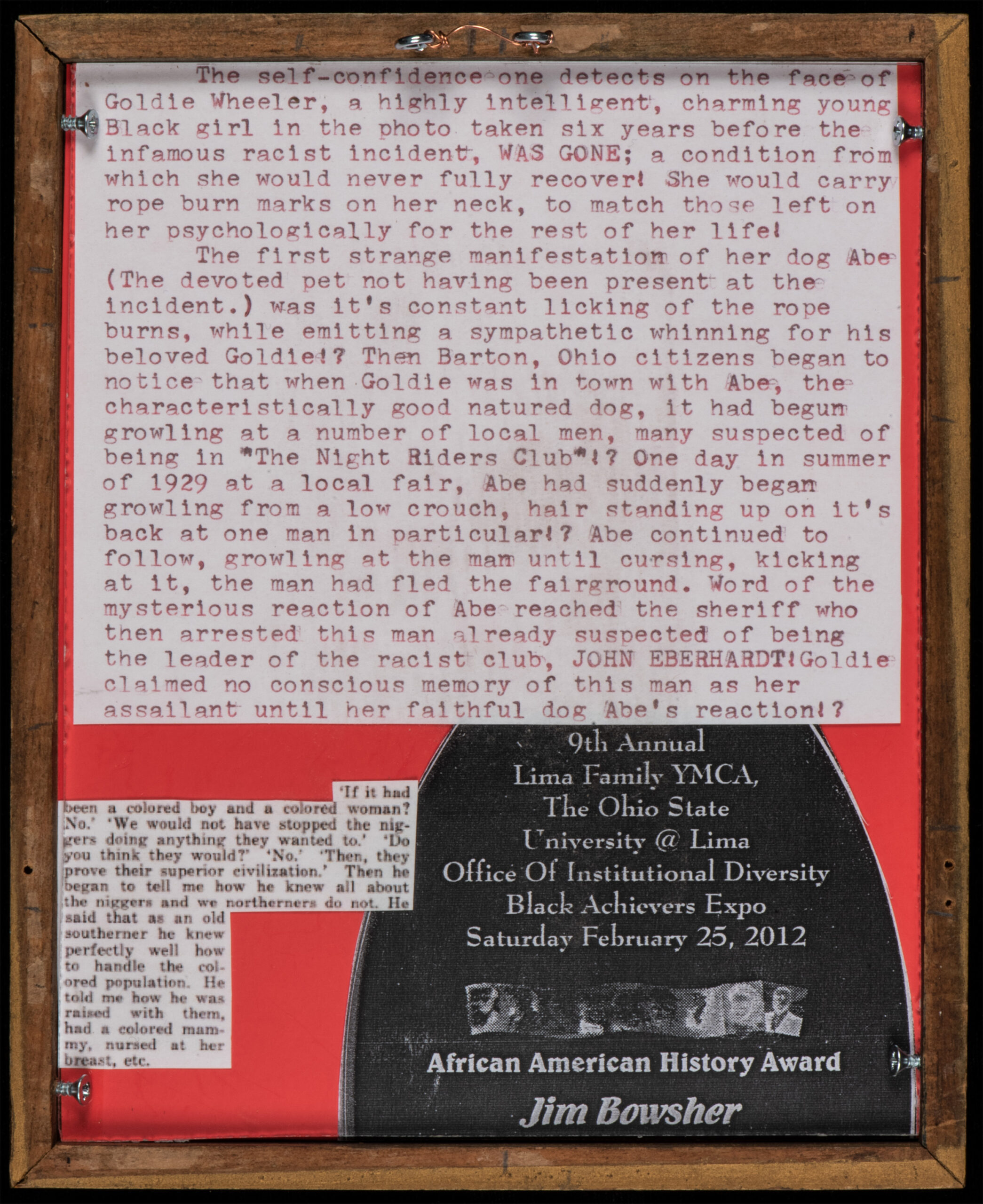

In these framed pieces, Jim tells the story of each object and, importantly, preserves his original research and documentation. In many instances, the story concludes on the back of the frame. In cases where the similarity of content may cause confusion for viewers, the beginning of the story is highlighted.