20th Century Wars
Night of Broken Glass
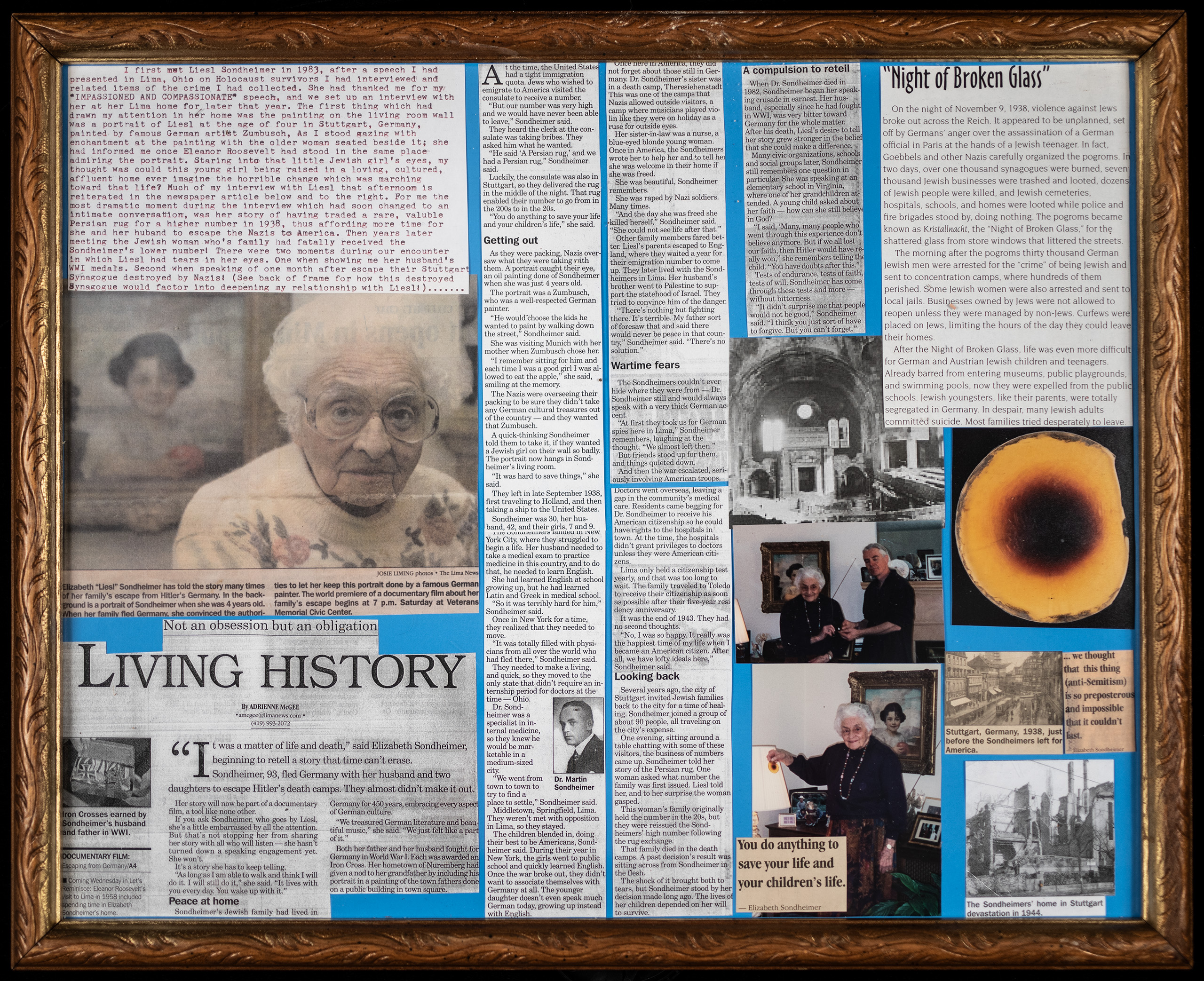
A poignant reminder of Liesl Sondheimer’s 1938 escape from Stuttgart, Germany is discovered.
A poignant reminder of Liesl Sondheimer’s 1938 escape from Stuttgart, Germany is discovered.

I first met Liesl Sondheimer in 1983, after a speech I had presented in Lima, Ohio, on Holocaust survivors I had interviewed and related items of the crime I had collected. She had thanked me for my “Impassioned and compassionate” speech, and we set up an interview with her at her Lima home for later that year.
The first thing which had drawn my attention in her home was the painting on the living room wall, a portrait of Liesl at the age of four in Stuttgart, Germany, painted by famous German artist Zumbusch, As I stood gazing with enchantment at the painting, with the older woman seated beside it, she informed me once Eleanor Roosevelt had stood in the same place admiring the portrait. Staring into that little Jewish girl’s eyes, my thought was could this young girl being raised in a loving, cultured, affluent home ever imagine the horrible change which was marching toward that life?
Much of my interview with Liesl that afternoon is reiterated in the newspaper article in the frame. For me the most dramatic moment during the interview which had soon changed to an intimate conversation, was her story of having traded a rare, valuable Persian rug for a higher number in 1938, thus affording more time for she and her husband to escape the Nazis to America. Then years later meeting the Jewish woman whose family had fatally received the Sondheimer’s lower number! There were two moments during our encounter in which Liesl had tears in her eyes. One when showing me her husband’s WWI medals. Second when speaking of one month after escape their Stuttgart Synagogue destroyed by Nazis.
Ten years after my 1983 Interview of Liesl Sondheimer, I had planned a trip to Europe. Beyond my plans for genealogical research, some archaeological work and historical interviewing, I had an idea while in Germany to visit Stuttgart to see if I might make a deeper personal connection to Liesl Sondheimer and her story. What she had not known about me was I had spent much of my lifetime gathering salvaged remains of historic buildings which had been torn down in and around Wapakoneta. Many times I would locate persons who had lived near a building at the time of it being razed, finding someone had retrieved pieces from its ruins. I would acquire these few surviving items, and incorporate them into my Temple Grounds as a repository of these physiological connections to Wapakoneta’s history.
In Stuttgart, I used a translator to locate through surviving property records the relatives of those who might have salvaged, saved something, some artifact from the 400-year-old Synagogue of Liesl Sondheimer’s German ancestors, which had been destroyed by Nazis on The Night of Broken Glass, “Kristallnacht,” on November 9th, 1938. After a three-day search, I was introduced to a young man whose father had given him a yellow piece of glass from four-centuries-old stained-glass window in the destroyed Synagogue’s debris! When I told the young man my reason for wanting to acquire this piece of history, with an arranged trade for some American Indian arrowheads, I had secured it.
Upon arriving home from Europe, I became so busy finishing my Temple, it wasn’t until 1999 I set up a meeting with Liesl at her home in Lima. When I finally showed Liesl the piece of glass, as she held it, pressed it to her heart…it seemed imbued with the whole history of Holocaust, destruction of a Synagogue, a city, a race!
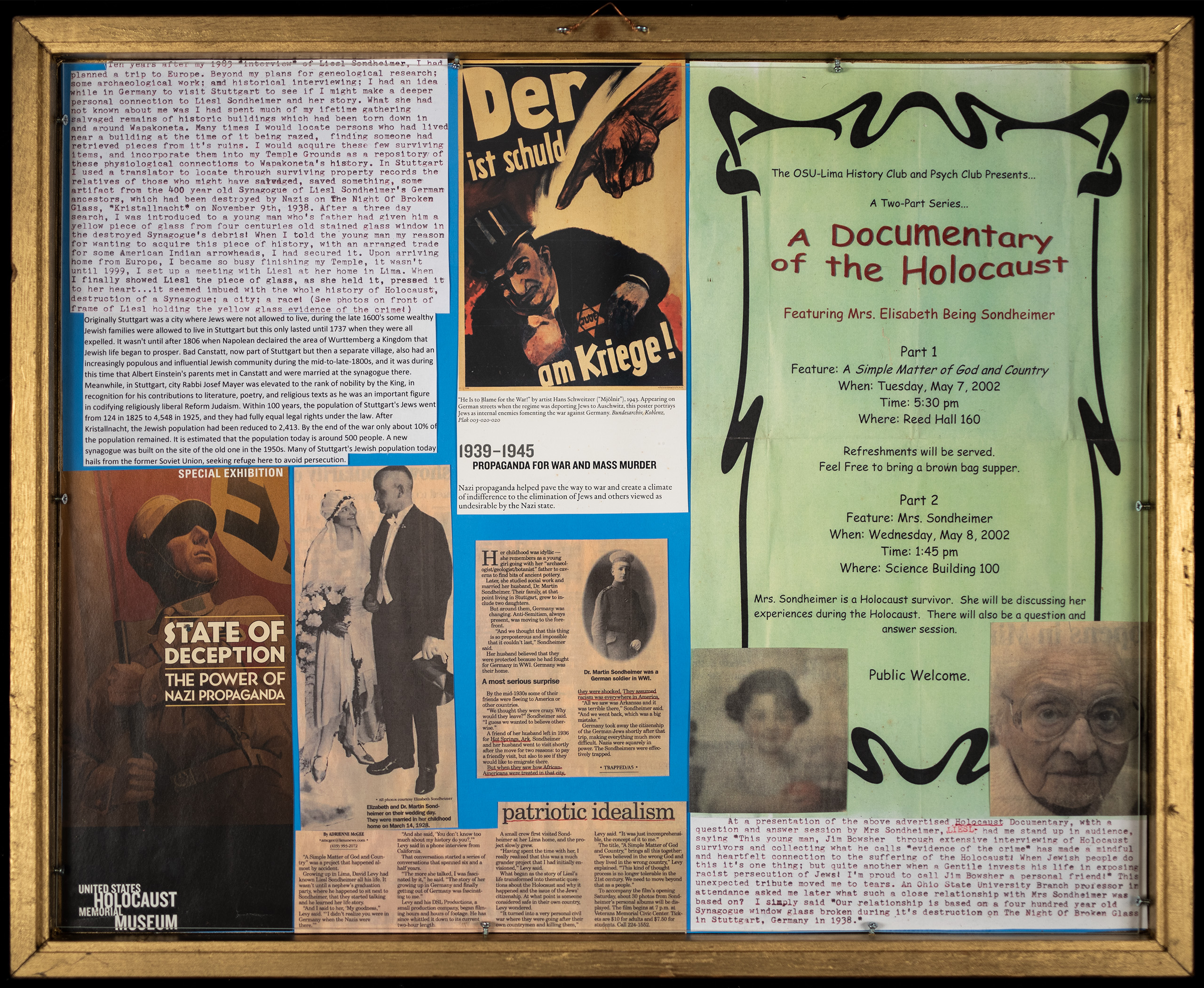

In these framed pieces, Jim tells the story of each object and, importantly, preserves his original research and documentation. In many instances, the story concludes on the back of the frame. In cases where the similarity of content may cause confusion for viewers, the beginning of the story is highlighted.