The Civil War
The Drummer Boy of Missionary Ridge
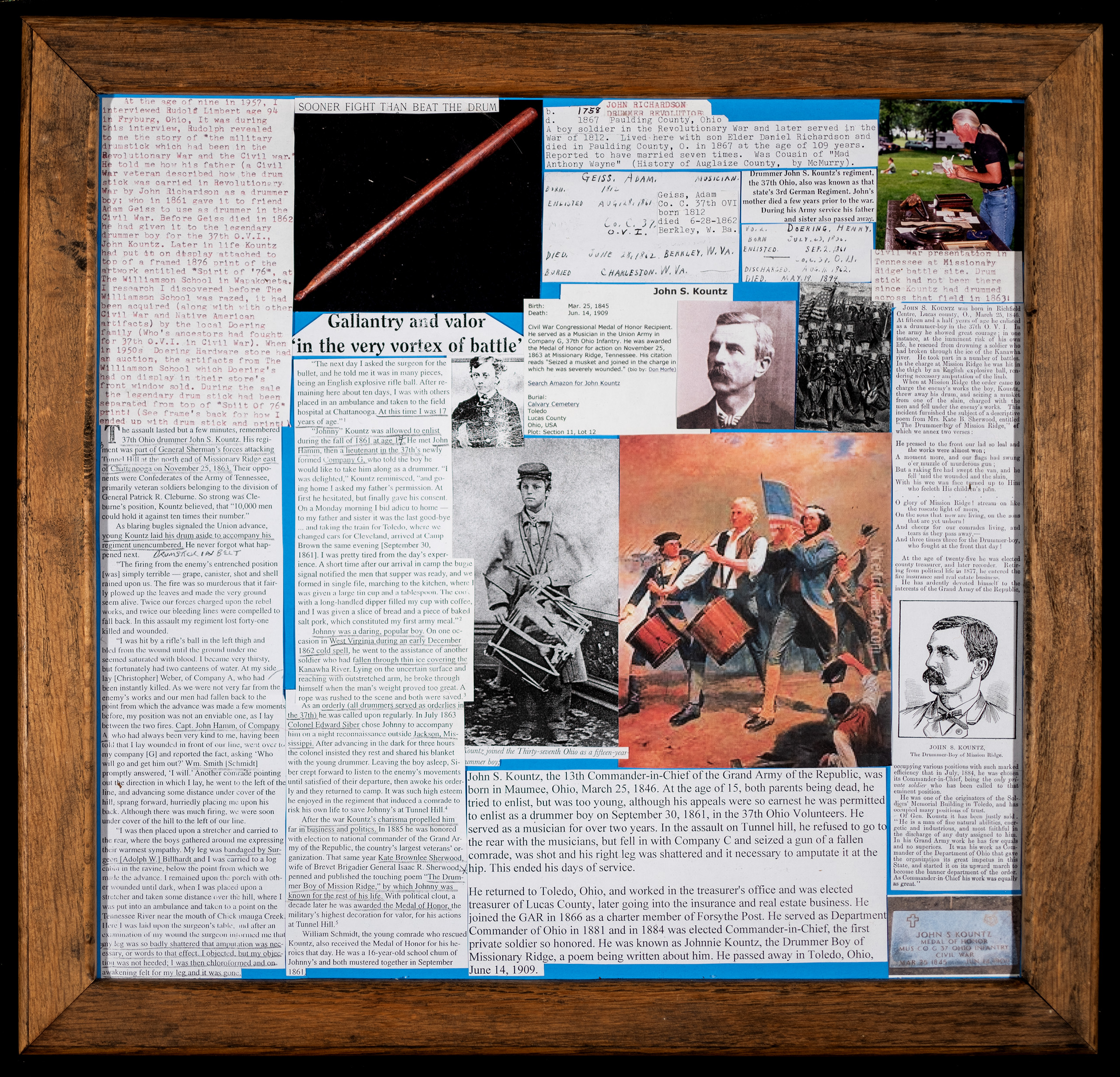
The journey of a drumstick, from the Revolutionary War to a window display in a small-town hardware store, is recounted.
The journey of a drumstick, from the Revolutionary War to a window display in a small-town hardware store, is recounted.

At the age of nine in 1957, I interviewed Rudolph Limbert age 94 in Fryburg, Ohio, It was during this interview, Rudolph revealed to me the story of the military drumstick which had been in the Revolutionary War and the Civil war. He told me how his father (a Civil War veteran) described how the drumstick was carried in Revolutionary War by John Richardson as a drummer boy, who in 1861 gave it to friend Adam Geiss to use as drummer in the Civil War. Before Geiss died in 1862 he had given it to the legendary drummer boy for the 37th O.V.I., John Kountz. Later in life Kountz had put it on display attached to top of a framed 1876 print of the artwork entitled “Spirit of ’76,” at The Williamson School in Wapakoneta. I research I discovered before The Williamson School was razed, it had been acquired (along with with othe Civil War and Native American artifacts) by the local Doering family (whose ancestors had fought for 37th O.V.I. in Civil War.) When in 1950s Doering Hardware store had an auction, the artifacts from The Willlamson School which Doering had on display in their store’s front window sold. During the sale the legendary drumstick had been separated from top of “Spirit Of 76” print!
In 1958, our mother accompanied my brother, age 13, and myself, age 10, to the Doering auction in front of the closed hardware store. This is where Mr Limbert one year before had informed me local Indian artifacts and Civil War relics (from The Willlamson School), including the drumstick on the top of the “Spirit Of 76,” were once on front window display. Searching through the sale items, I finally spotted the 1876 Willard print “Spirit of 76,” but the hooks on top of the frame which had held the historical “two wars” drumstick were empty! Our mother had told us, within reason, she would purchase a couple items we desired. With joy I purchased the unrecognized print for three dollars, while my brother Walt prepared to bid on the Indian relics. I searched again the sale items for the drumstick. It wasn’t there! In despair standing there with my framed print with those empty hooks, I suddenly noticed sticking out of one of the coffee cans of Indian artifacts… THE DRUMSTICK! The other older collectors of Indian relics seeing we were with our mother, allowed my brother whom had not bid higher against him to buy cheaply two cans of Indian artifacts, INCLUDING THE CAN CONTAINING THE DRUMSTICK! The other older bidders had no knowledge of the lone drumstick’s historical significancel At home, as I placed the drumstick back on the hooks at the top of the “Spirit Of 76” frame, I cried with joy not for personal possession of the drum stick, but personally honored by preservation of important piece of local history!


In these framed pieces, Jim tells the story of each object and, importantly, preserves his original research and documentation. In many instances, the story concludes on the back of the frame. In cases where the similarity of content may cause confusion for viewers, the beginning of the story is highlighted.